Defining the Family Through Communication Publisher and Year
7.three Advice and Families
Learning Objectives
- Compare and contrast the various definitions of family.
- Draw various types of family rituals and explain their importance.
- Explain how conformity and conversation orientations work together to create different family climates.
At that place is no doubt that the definition and makeup of families are irresolute in the U.s.a.. New data from research organizations and the 2010 United states of america Census show the following: people who choose to marry are waiting longer, more than couples are cohabitating (living together) before marriage or instead of marrying, households with more than ii generations are increasing, and the average household size is decreasing (Pew Research Eye, 2010). Merely equally the makeup of families changes, so do the definitions.
Defining Family
Who do you consider function of your family? Many people would initially name people who they are related to by blood. You may as well name a person with whom you are in a committed relationship—a partner or spouse. Just some people have a person non related by blood that they might refer to equally aunt or uncle or fifty-fifty equally a brother or sister. We can see from these examples that it's non simple to define a family.
The definitions people ascribe to families usually fall into at least ane of the following categories: structural definitions, task-orientation definitions, and transactional definitions (Segrin & Flora, 2005). Structural definitions of family focus on form, criteria for membership, and often bureaucracy of family members. One example of a structural definition of family is ii or more than people who alive together and are related past birth, marriage, or adoption. From this definition, a father and son, ii cousins, or a brother and sis could be considered a family if they live together. However, a single person living alone or with nonrelated friends, or a couple who chooses not to or are non legally able to marry would not be considered a family. These definitions rely on external, "objective" criteria for determining who is in a family unit and who is not, which makes the definitions useful for groups like the US Demography Bureau, lawmakers, and other researchers who demand to define family for large-scale data drove. The simplicity and time-saving positives of these definitions are countered by the fact that many family types are left out in general structural definitions; however, more than specific structural definitions have emerged in recent years that include more family forms.
Family of origin refers to relatives continued past blood or other traditional legal bonds such equally union or adoption and includes parents, grandparents, siblings, aunts, uncles, nieces, and nephews. Family of orientation refers to people who share the same household and are connected by blood, legal bond, or who human activity/live every bit if they are connected by either (Segrin & Flora, 2005). Different family of origin, this definition is limited to people who share the same household and represents the family makeup nosotros choose. For example, most young people don't get to choose who they alive with, only every bit we get older, we choose our spouse or partner or may cull to accept or adopt children.
There are several subdefinitions of families of orientation (Segrin & Flora, 2005). A nuclear family unit includes two heterosexual married parents and 1 or more children. While this type of family has received a lot of political and social attention, some scholars debate that information technology was only dominant as a family course for a brief part of human history (Peterson & Steinmetz, 1999). A binuclear family is a nuclear family that was split by divorce into two divide households, one headed past the mother and i by the father, with the original children from the family residing in each dwelling for periods of fourth dimension. A unmarried-parent family includes a mother or father who may or may not have been previously married with ane or more than children. A stepfamily includes a heterosexual couple that lives together with children from a previous relationship. A cohabitating family unit includes a heterosexual couple who lives together in a committed relationship but does not have a legal bond such as spousal relationship. Similarly, a gay or lesbian family includes a couple of the same gender who live together in a committed relationship and may or may non have a legal bail such equally marriage, a civil union, or a domestic partnership. Cohabitating families and gay or lesbian families may or may not have children.
Is it more than important that the structure of a family unit matches a definition, or should we ascertain family unit based on the behavior of people or the quality of their interpersonal interactions? Unlike structural definitions of family, functional definitions focus on tasks or interaction within the family unit. Task-orientation definitions of family recognize that behaviors like emotional and financial back up are more than important interpersonal indicators of a family-similar connection than biology. In curt, anyone who fulfills the typical tasks nowadays in families is considered family. For case, in some cases, custody of children has been awarded to a person not biologically related to a child over a living blood relative because that person acted more like a family member to the kid. The most mutual family tasks include nurturing and socializing other family members. Nurturing family members entails providing bones care and support, both emotional and financial. Socializing family members refers to pedagogy young children how to speak, read, and practice social skills.
Transactional definitions of family focus on advice and subjective feelings of connexion. While task-orientation definitions convey the importance of providing for family members, transactional definitions are concerned with the quality of interaction among family members. Specifically, transactional definitions stress that the creation of a sense of home, group identity, loyalty, and a shared by and future makes upwardly a family unit. Isn't it true that someone could provide food, shelter, and transportation to schoolhouse for a kid simply not create a sense of habitation? Even though there is no one, all-encompassing definition of family unit, possibly this is for the best. Given that family is a combination of structural, functional, and communicative elements, it warrants multiple definitions to capture that complexity.
Family Communication Processes
Think about how much time we spend communicating with family members over the course of our lives. As children, well-nigh of u.s. spend much of our time talking to parents, grandparents, and siblings. As we go adolescents, our peer groups become more cardinal, and nosotros may fifty-fifty begin to resist communicating with our family during the rebellious teenage years. Still, as nosotros begin to cull and class our ain families, we over again spend much time engaging in family unit advice. Additionally, family unit advice is our primary source of intergenerational advice, or communication betwixt people of different historic period groups.
Family unit Interaction Rituals
Y'all may have heard or used the term family time in your own families. What does family time mean? As was discussed earlier, relational cultures are built on interaction routines and rituals. Families also have interaction norms that create, maintain, and alter advice climates. The notion of family unit time hasn't been around for as well long but was widely communicated and represented in the popular culture of the 1950s (Daly, 2001). When we think of family time, or quality time as information technology'south sometimes called, we commonly call back of a romanticized ideal of family unit time spent together.
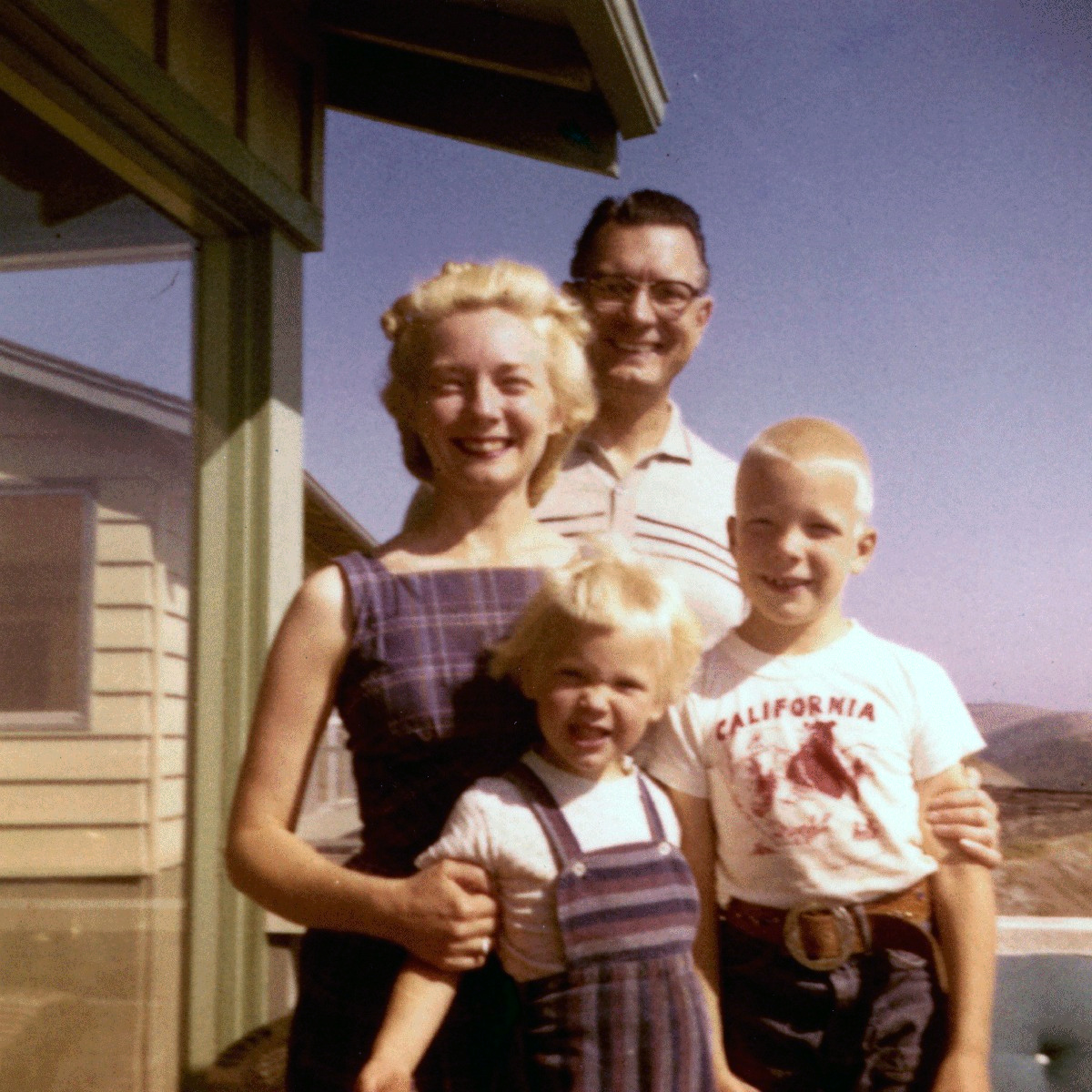
The nuclear family was the subject of many television shows in the 1950s that popularized the idea of family time.
While family unit rituals and routines can definitely be fun and entertaining bonding experiences, they can as well bring about interpersonal disharmonize and strife. Simply think near Clark Westward. Griswold's string of well-intentioned but misguided attempts to manufacture family unit fun in the National Lampoon's Vacation series.
Families engage in a diversity of rituals that demonstrate symbolic importance and shared beliefs, attitudes, and values. Iii primary types of relationship rituals are patterned family interactions, family traditions, and family celebrations (Wolin & Bennett, 1984). Patterned family interactions are the nearly frequent rituals and exercise non have the degree of formality of traditions or celebrations. Patterned interactions may include mealtime, bedtime, receiving guests at the house, or leisure activities. Mealtime rituals may include a rotation of who cooks and who cleans, and many families have gear up seating arrangements at their dinner table. My family has recently adopted a new leisure ritual for family unit gatherings by playing corn hole (besides known as bags). While this family activity is not formal, information technology's get something expected that we expect forward to.
Family traditions are more than formal, occur less frequently than patterned interactions, vary widely from family unit to family, and include birthdays, family reunions, and family unit vacations. Birthday traditions may involve a trip to a favorite eating house, blistering a cake, or hanging streamers. Family reunions may involve making t-shirts for the group or counting up the collective age of everyone present. Family route trips may involve predictable conflict between siblings or playing car games like "I spy" or trying to notice the almost number of license plates from unlike states.
Last, family celebrations are also formal, have more standardization between families, may be culturally specific, assistance transmit values and memories through generations, and include rites of passage and religious and secular holiday celebrations. Thanksgiving, for case, is formalized by a national holiday and is historic in similar ways past many families in the The states. Rites of passage marker life-cycle transitions such as graduations, weddings, quinceañeras, or bar mitzvahs. While graduations are secular and may vary in terms of how they are historic, quinceañeras have cultural roots in Latin America, and bar mitzvahs are a long-established religious rite of passage in the Jewish religion.
Conversation and Conformity Orientations
The corporeality, latitude, and depth of conversation between family members varies from family unit to family. Additionally, some families encourage cocky-exploration and freedom, while others expect family unity and control. This variation can be better understood by examining 2 key factors that influence family communication: conversation orientation and conformity orientation (Koerner & Fitzpatrick, 2002). A given family can exist higher or lower on either dimension, and how a family rates on each of these dimensions tin can exist used to determine a family blazon.
To determine chat orientation, nosotros determine to what caste a family encourages members to collaborate and communicate (antipodal) about various topics. Members within a family with a high conversation orientation communicate with each other freely and frequently about activities, thoughts, and feelings. This unrestricted communication style leads to all members, including children, participating in family decisions. Parents in high-chat-orientation families believe that communicating with their children openly and frequently leads to a more rewarding family life and helps to educate and socialize children, preparing them for interactions outside the family. Members of a family unit with a low conversation orientation do not collaborate with each other equally oft, and topics of conversation are more restricted, as some thoughts are considered private. For instance, non everyone's input may be sought for decisions that bear upon everyone in the family, and open and frequent communication is not deemed of import for family unit functioning or for a child's socialization.
Conformity orientation is determined by the degree to which a family advice climate encourages conformity and agreement regarding beliefs, attitudes, values, and behaviors (Koerner & Fitzpatrick, 2002). A family with a high conformity orientation fosters a climate of uniformity, and parents decide guidelines for what to conform to. Children are expected to be obedient, and conflict is oft avoided to protect family harmony. This more traditional family model stresses interdependence among family members, which means infinite, money, and time are shared amidst immediate family, and family relationships take precedent over those outside the family. A family with a low conformity orientation encourages diversity of beliefs, attitudes, values, and behaviors and assertion of individuality. Relationships outside the family are seen as important parts of growth and socialization, as they teach lessons about and build conviction for independence. Members of these families also value personal time and space.
"Getting Real"
Family Therapists
Family therapists provide counseling to parents, children, romantic partners, and other members of family units (Career Cruising, 2011). People may seek out a family therapist to deal with difficult past experiences or current problems such as family conflict, emotional processing related to grief or trauma, marriage/relationship stresses, children'due south behavioral concerns, and so on. Family unit therapists are trained to appraise the systems of interaction inside a family through counseling sessions that may be one-on-i or with other family members present. The therapist and so evaluates how a family's patterns are affecting the individuals within the family. Whether through social services or private practice, family therapy is usually short term. Once the cess and evaluation is complete, goals are established and sessions are scheduled to runway the progress toward completion. The demand for family unit therapists remains strong, equally people's lives abound more complex, careers have people away from support networks such as family and friends, and economic hardships touch on interpersonal relationships. Family therapists normally have bachelor'due south and master's degrees and must obtain a license to practice in their state. More information about family and marriage therapists tin be constitute through their professional organization, the American Association for Marriage and Family Therapy, at http://world wide web.aamft.org.
- List some issues within a family that you lot think should be addressed through formal therapy. List some issues within a family that you think should exist addressed directly with/past family members. What is the line that distinguishes between these two levels?
- Based on what you've read in this book so far, what communication skills do you call up would be nearly beneficial for a family unit therapist to possess and why?
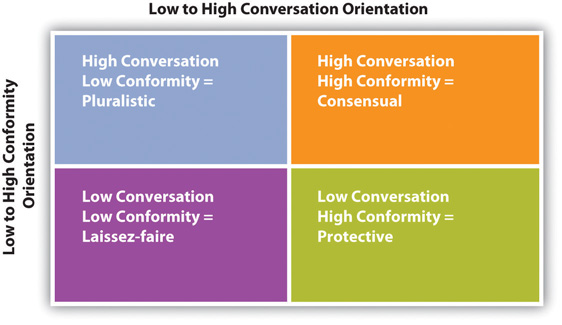
Determining where your family falls on the conversation and conformity dimensions is more instructive when you know the family types that result, which are consensual, pluralistic, protective, and laissez-faire (come across Figure vii.2 "Family Types Based on Conflict and Conformity Orientations") (Koerner & Fitzpatrick, 2002). A consensual family unit is high in both conversation and conformity orientations, and they encourage open communication but also desire to maintain the hierarchy inside the family that puts parents in a higher place children. This creates some tension between a want for both openness and control. Parents may reconcile this tension past hearing their children's opinions, making the ultimate decision themselves, and then explaining why they made the determination they did. A pluralistic family unit is loftier in conversation orientation and low in conformity. Open discussion is encouraged for all family members, and parents do not strive to control their children'due south or each other'southward behaviors or decisions. Instead, they value the life lessons that a family fellow member can learn past spending time with non–family members or engaging in self-exploration. A protective family is low in conversation orientation and high in conformity, expects children to exist obedient to parents, and does non value open up communication. Parents make the ultimate decisions and may or may not feel the demand to share their reasoning with their children. If a child questions a decision, a parent may simply reply with "Because I said so." A laissez-faire family is depression in chat and conformity orientations, has infrequent and/or curt interactions, and doesn't talk over many topics. Call up that pluralistic families also have a low conformity orientation, which means they encourage children to make their own decisions in order to promote personal exploration and growth. Laissez-faire families are dissimilar in that parents don't have an investment in their children's decision making, and in general, members in this type of family are "emotionally divorced" from each other (Koerner & Fitzpatrick, 2002).
Effigy vii.2 Family Types Based on Disharmonize and Conformity Orientations
Key Takeaways
-
There are many ways to define a family unit.
- Structural definitions focus on form of families and have narrow criteria for membership.
- Task-orientation definitions focus on behaviors similar financial and emotional support.
- Transactional definitions focus on the creation of subjective feelings of home, grouping identity, and a shared history and future.
- Family rituals include patterned interactions like a nightly dinner or bedtime ritual, family traditions like birthdays and vacations, and family celebrations like holidays and weddings.
-
Chat and conformity orientations play a role in the creation of family climates.
- Conversation orientation refers to the degree to which family members collaborate and communicate well-nigh diverse topics.
- Conformity orientation refers to the degree to which a family unit expects uniformity of behavior, attitudes, values, and behaviors.
- Conversation and conformity orientations intersect to create the post-obit family climates: consensual, pluralistic, protective, and laissez-faire.
Exercises
- Of the 3 types of definitions for families (structural, task-orientation, or transactional), which is most important to y'all and why?
- Identify and depict a ritual yous have experienced for each of the following: patterned family interaction, family unit tradition, and family commemoration. How did each of those come to exist a ritual in your family?
- Call back of your own family and identify where you lot would autumn on the conversation and conformity orientations. Provide at least one slice of show to back up your decision.
References
Career Cruising, "Marriage and Family Therapist," Career Cruising: Explore Careers, accessed October 18, 2011, http://www.careercruising.com.
Daly, K. J., "Deconstructing Family unit Fourth dimension: From Ideology to Lived Experience," Journal of Marriage and the Family 63, no. 2 (2001): 283–95.
Koerner, A. F. and Mary Anne Fitzpatrick, "Toward a Theory of Family Communication," Advice Theory 12, no. 1 (2002): 85–89.
Peterson, G. West. and Suzanne M. Steinmetz, "Perspectives on Families as We Arroyo the Xx-first Century: Challenges for Future Handbook Authors," in The Handbook of Union and the Family unit, eds. Marvin B. Sussman, Suzanne K. Steinmetz, and Gary Due west. Peterson (New York: Springer, 1999), two.
Pew Research Eye, "The Pass up of Marriage and Rise of New Families," November xviii, 2010, accessed September 13, 2011, http://pewsocialtrends.org/files/2010/eleven/pew-social-trends-2010-families.pdf.
Segrin, C. and Jeanne Flora, Family Communication (Mahwah, NJ: Lawrence Erlbaum, 2005), 5–xi.
Wolin, S. J. and Linda A. Bennett, "Family Rituals," Family Procedure 23, no. 3 (1984): 401–20.
Source: https://open.lib.umn.edu/communication/chapter/7-3-communication-and-families/
0 Response to "Defining the Family Through Communication Publisher and Year"
Post a Comment